
One agency, from first look to six measured weeks.
A recruitment agency of about ten people put Claude to work inside JobAdder across the whole team. This is what happened, in order, with the numbers we reported to the owners each week. Their name stays private. The numbers are real.
What the work was.
Get Claude working inside JobAdder for every consultant, safely, each under their own login. Find out what was holding the database back. Teach people to use it on their real work, then measure whether they did.
Along the way the owners asked us to plan three more things: rules and a clean-up for their data, a page where old candidates update their own details, and a new website.
They had years of candidates in JobAdder and no time to keep the records tidy, so every search came back fuller than it should.
The engagement, in order.
Early weeks are counted from the start. Once the team was set up, every week got its own report.
Agreement signed
A founding pilot: the agency went first, and helped shape what came after.
Four discovery sessions, on the desk
A consultant's day from sourcing to notes. Operations, reporting and JobAdder administration. The owners' priorities. Then a working session on CV floats, templates and saved prompts. The connector was tested live from the second session.
The connector hardened from live use
Nine fixes and more, from what the team ran into while testing. We switched deleting off.
The data, measured
4,347 client records analysed for duplicates, office networks and location coding. 33,820 candidates sampled through the connector: 91% marked Active, one created in 1999 and still Active, and 24 marked Do Not Contact.
The owners decide
The owners approved the website, asked for quotes on the data rules, the client clean-up and the candidate update site, and put the full candidate clean-up off until the rules exist. Deleting stayed off.
Handbook, deck and skills
A searchable team handbook with a reference to all 174 connector tools, a training deck with presenter notes, and saved skills for the daily call list and logging calls.
Measured week one
1,014 requests, six people, three different ways of working. 0.6% failed.
The filter fault
An owner's report about a note search led to one encoding fault that was dropping list filters across 18 tool groups. Fixed and deployed that week.
The peak, and the honest number
8,036 requests. 93% were reading. Two people used the whole toolkit.
The call list moves onto the server
One request instead of about a thousand lookups. Requests fell to 2,655 and changes written back rose to 72.
A team version of the report
Totals, wins and one thing to try, with nobody ranked. The owners keep the full version.
Six weeks, as reported.
A request is one call to JobAdder: a search, opening a record, writing a note. One question from a consultant often takes several. A change is anything created or updated in JobAdder.
| Week | Requests | People using it | Changes written | Failed |
|---|---|---|---|---|
| 1 | 1,014 | 6 of 8 | 137 | 0.6% |
| 2 | 2,889 | 7 of 7 | 152 | 0.2% |
| 3 | 5,653 | 7 of 7 | 184 | 0.3% |
| 4 | 8,036 | 7 of 7 | 67 | 0.4% |
| 5 (four days) | 2,655 | 7 of 7 | 72 | 1.0% |
| 6 | 2,421 | 7 of 7 | 53 | 0.2% |
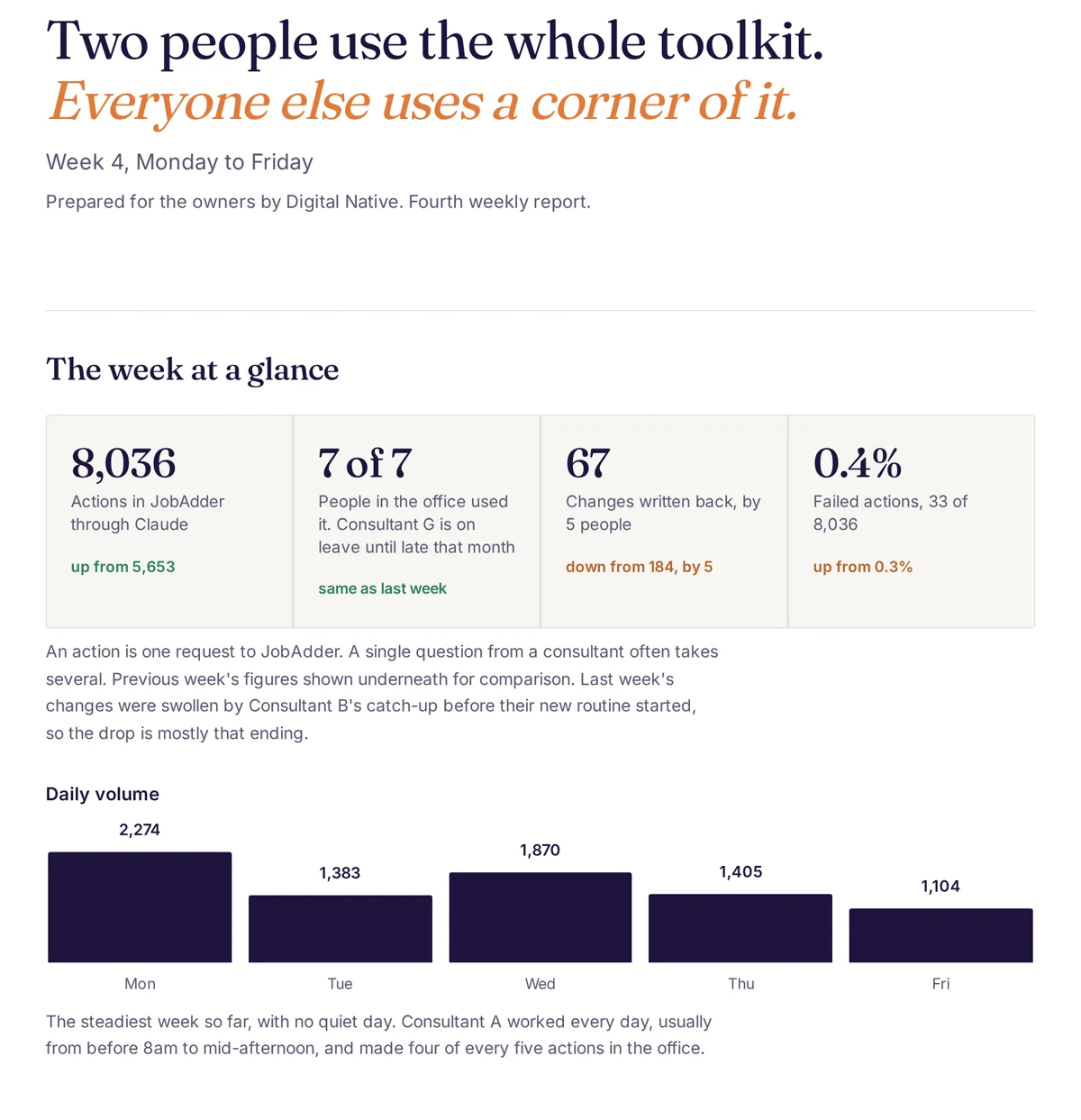
A page from the real report.
The top of the week 4 report, as the owners received it. We've replaced the names with letters and the dates with the week number, and taken out one paragraph that quoted the owner. The rest is as sent, including the bad news in the headline.
What did not go to plan.
Every one of these was in a weekly report before it went on this page.
Week three, the base narrowed
Volume nearly doubled, but two people made 88% of the requests and one person wrote 87% of the changes. The week before, we'd reported wider use. This week we reported that it had narrowed.
Week four, mostly reading
93% of requests were finding and reading records. That led to the team version of the report and its weekly ‘one thing to try’.
Week five, a routine went quiet
One consultant's saved routine stopped showing up in the numbers. We flagged it and asked whether it was paused on purpose, rather than guess.
JobAdder said no
JobAdder refused some new tasks more than once. We asked to go through one with the person who hit it, rather than retry blind.
What the agency has now.
- A connector locked to their accountNativeMCP, our managed connector, locked to their JobAdder account. Every consultant signs in as themselves.
- A team handbookGetting started, working with Claude, the JobAdder connector and help, with search and a reference to all 174 tools.
- Saved skills and a routineThe daily call list, built on our server from each consultant's saved rules, and a skill for logging calls.
- Two weekly reportsA management report with each person's numbers, and a team version with no rankings.
- A client portalOne place for the timeline, decisions, documents and what's next.
- Scoped, costed next stepsData rules and a client clean-up, a site where old candidates update their details, and consistent locations. The website is in build.
Also: a recruitment website, built then rebuilt from research.
Specpro People is our own field service and sales recruitment brand. We built specpro.com.au in a day, researched its market the next, then rebuilt it around what we found.
The research
We looked at the competition in four rings, from local agencies to doing it yourself: 54 agencies in Australia and overseas. We pulled apart 15 of their websites, profiled 13, and gathered 86 quotes from employers and candidates. Thirteen recommendations came out of it, and the site took every one it could.
The site
- 18 pages, including role pages, guides under the director's name, and a jobs page set up so Google can list the jobs.
- Automated accessibility checks (WCAG 2.2 AA) on every page found no issues.
- Works on any screen from a small phone to a large monitor, and with large text.